|
||||||||
|
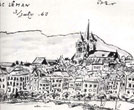
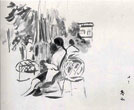
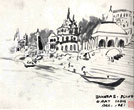
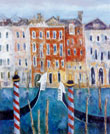
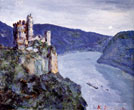
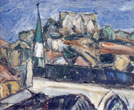
Kanetomo Matsushita, the first superintending director of this facility, in addition to being active as a doctor at and the director of the Fukuyama Hospital and a member of the board of directors of the Tachibana Committee for Social Welfare, actively sketched and painted. In his student days, he received instruction in oil painting from the artist Zenzaburo Kojima and when he traveled throughout the world on business, whenever he was able to find the time, he sketched and painted right up until the time of his death at 84, in 1989. Except when there is a special exhibit, his works may be found in Building 6 under the title The Posthumous Works of Kanetomo Matsushita. |
||||||||
|
A Message from Kanetomo Matsushita It would appear that I inherited my father's love of art, for I was interested in painting from the beginning. With an interest in becoming an artist, I had thought to attend an art school but being physically weak that ended as a dream. Starting in April 1924, and during my time in the medical training course at Shichiko, Ajisaka, Saita and I held exhibitions of oil paintings at the annual Shichiko Commemorative Festival, and I made and distributed postcards that I'd painted as well. On occasion I'd skip class and head out to sketch the area around Akune, and on one such occasion I caught hell from my math teacher. In 1929, after entering Nagasaki Medical School, I often held exhibitions of my oil paintings and was praised by the school's President, Mr. Hayashi. But when I began studying psychiatry with Professor Hidemitsu Kure (a pupil of Professor Kiyoshi Takase) and was consumed with the making of pathological specimens, I had no time to fuss with painting and for a number of years did not take up a brush. But I didn't lose my interest in painting. I was instructed by Zenzaburo Kojima, and one summer I went to the Nasu region of Tochigi Prefecture, sat on the bank of the Hoki River, and completed a painting in one sitting. That painting was burned by the atomic bomb. In 1933, after graduating from Nagasaki Medical School, I took a job working in the Psychiatry Department there for 45 yen a month. Right around that time, an exhibit of paintings by Rikizo Takada, who had painted in Paris, was held in Nagasaki. I bought his painting Morning in Paris (No.4) for 85 yen and took it home with me in a state of rapture only to be severely reprimanded by my wife Keiko. Just before the end of the war, on August 8, I was unfortunately in Nagasaki when the bomb was dropped. I narrowly escaped death and returned home to Fukuyama. In 1950, in the middle of two hectares of land where my father was growing tangerines, I built a mental hospital. While concentrating on the treatment of patients during the day, somewhere in my heart I continued to long for painting. Paintings contain tenderness and serenity, feelings that I believe are conveyed to mental patients. A number of years passed in this way. I came to have a more comfortable life, and I traveled throughout the world, sketched, and threw nearly all that I had into the purchase of paintings by famous artists and into ancient earthenware. In these works of art and ancient artifacts I felt a limitless mystery and power. These masterpieces provided me with invisible hints that informed the formation of my own sensibilities. When I had collected a large number of paintings, I realized that only in the oil paintings by foreigners could I find a brilliance of individuality and expression. |
||||||||
I traveled to art museums around the world. I visited the Louvre, in Paris, four or five times, the Metropolitan Museum of Art, in New York City, art museums in Russia, Spain and so on. It may be rude of me to say this, but no matter how much attention an oil painting by a Japanese artist may receive in Japan, it is incomparable to the works of foreigners. I have often attended auctions in Paris, and of the works by Japanese artists only those by Tsuguharu Fujita are to be found there.
Japan's artists should return once again to their origins, and tackle landscape painting. And isn't there the need for the Ministry of Culture as well, to turn its attention more to Japanese-style painting and the uniquely Japanese woodblock prints, thereby inducing the people of the world to look upon Japanese painting? Japanese artists will probably criticize this the statement of a doctor and one who has not graduated from an art school. And I will bear their criticism, no matter how much they reproach me.
|
||||||||
 |
||||||||
|
||||||||